Why Hagia Sophia still stops visitors cold
The first thing that hit me wasn’t the scale—it was the sudden hush that happens even when the courtyard is busy. You step through the threshold expecting “another big landmark,” and your brain stalls for a second as the dome seems to float above you. It’s a rare place where the wow-factor isn’t marketing; it’s geometry, light, and the feeling that the building has outlived every tidy category you’d like to put it in.
What makes Hagia Sophia genuinely arresting (and a little hard to plan) is that it’s not a frozen museum set-piece. It’s a working mosque with a visitor flow layered on top, so the experience changes depending on time of day, prayer schedule, and crowd density. On a short Sultanahmet stay, that unpredictability matters: arrive at the wrong moment and you’ll spend your best hour in security queues or outside during restricted access; arrive at a smart moment and you can get the full, spine-tingling interior before the space turns into a slow-moving human conveyor belt.
What it is today: mosque, museum, monument
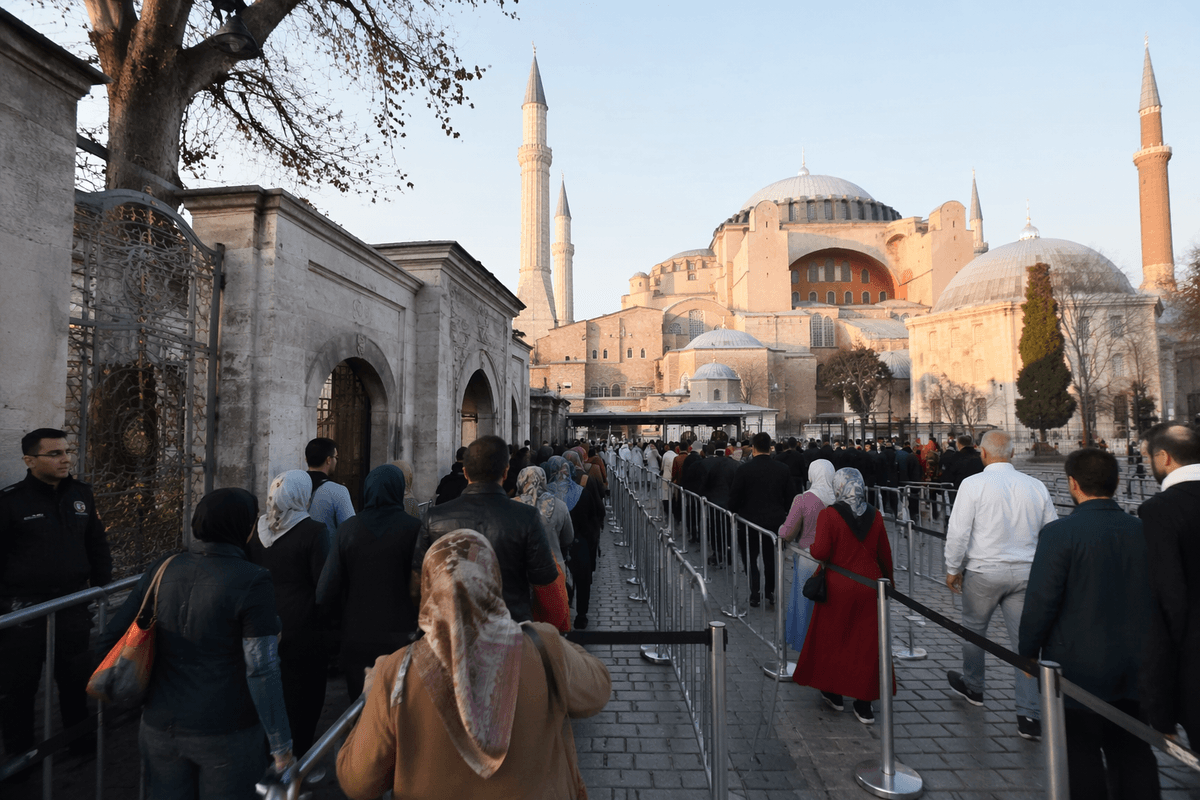
I hesitated outside because the signage makes one thing clear and one thing confusing: Hagia Sophia is “open,” but not in the museum sense. It functions first as a mosque, which means the main prayer hall is managed around worship, and visitor access is deliberately channeled so sightseeing doesn’t spill into the prayer flow. If you arrive expecting to wander freely on the ground floor, you’ll waste time recalibrating (and possibly queuing in the wrong place).
In practice, there are two tracks. Worshippers enter separately and don’t buy a ticket; most first-time visitors, meanwhile, are routed to the paid tourist circuit that takes you up into the upper galleries (the perspective is excellent, but it’s not the same as standing under the dome at floor level). The current foreign-visitor ticket is set at €25, with free entry for children under 8, and it’s very much a “single monument” setup—don’t assume an Istanbul museum pass covers it.
The “working mosque” reality shows up in two places: prayer-time pauses (Friday midday is the most disruptive) and dress enforcement. Shoulders and knees need to be covered, and women are expected to cover hair; if you misjudge it, you can usually buy coverings at the entrance, but it’s an avoidable delay when lines are already thick.
Best times to go and what to avoid
The moment you realize you’re moving at the speed of the slowest photo stop is the moment “anytime is fine” stops being true. If you can, aim for early morning on a weekday: security and ticket checks still take time, but the flow is smoother and the upper galleries feel more like a viewpoint than a congested corridor. Late afternoon can also work, but it’s more fragile—one tour-wave or a small access pause and you’ll watch your margin evaporate.
What I’d actively avoid on a short Sultanahmet stay: Friday midday (the most likely to collide with congregational prayer routines), and the middle of the day in peak season when the sun, cruise-day crowds, and tour groups stack on top of each other. You don’t just wait longer; you see less, because you’re constantly being nudged onward.
If you’re deciding between “dress properly at the hotel” versus “sort it at the entrance,” pick the hotel. Scarves and cover-ups are easy to buy, but that little stop becomes a real delay when lines are thick—and you’ll feel it most when you’re trying to time Hagia Sophia alongside nearby heavy-hitters like the Blue Mosque or Basilica Cistern.
Tickets, entry routes, and security realities
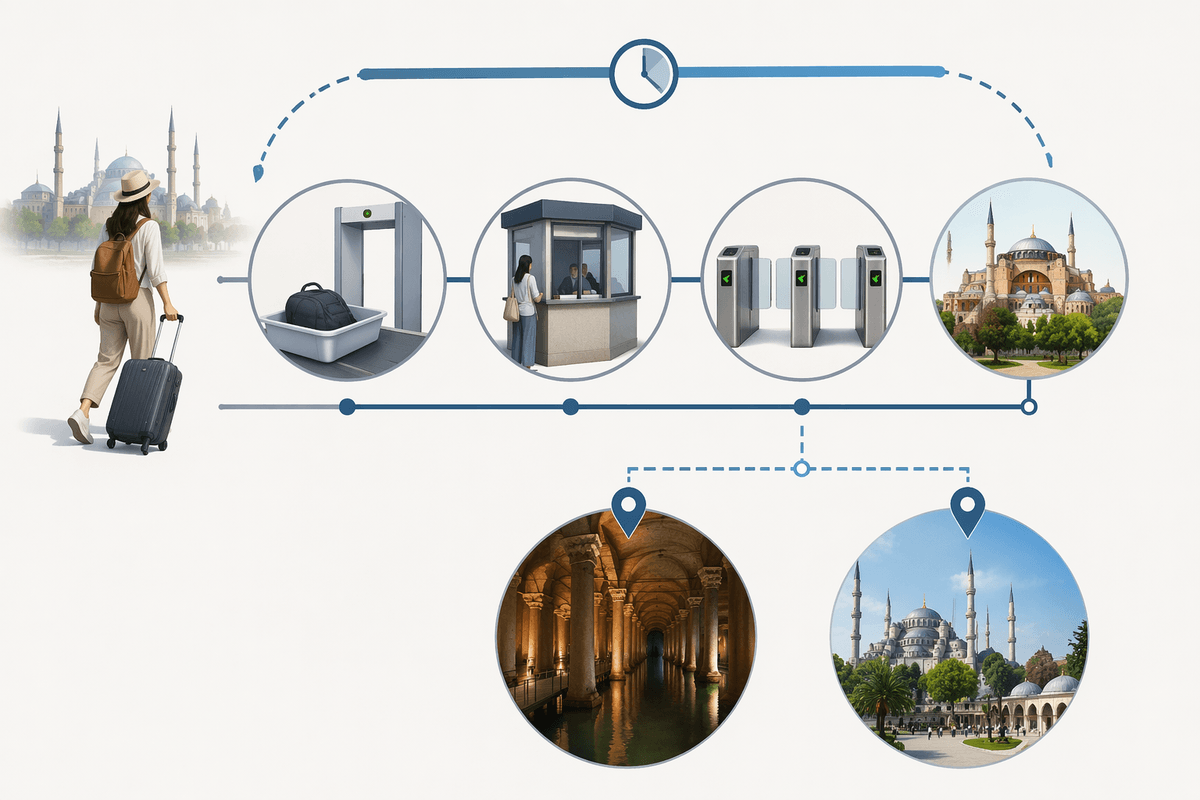
I thought I was being efficient by arriving with a ticket plan in mind—then I saw three distinct “flows” forming outside and realized half the battle is simply joining the right one. The worshipper entrance moves differently from the tourist entrance, and staff will redirect you, but that correction costs time when the forecourt is already jammed. If you’re visiting as a tourist, commit to the paid route up to the upper galleries; don’t hover at ground-level doors hoping for an “easy” way in, because that’s where confusion (and backtracking) tends to happen.
Security is the fixed cost you can’t bargain with. Even on a calm weekday morning, expect an airport-lite bag check, and plan your timing like there’s a hard gate before you see anything beautiful. Large bags slow you down and sometimes trigger extra screening, so this is one of those rare Sultanahmet mornings when leaving the daypack at the hotel actually pays off. The other friction point is clothing: if you’re borderline on knees/shoulders or you need a headscarf, you can usually solve it on-site, but you’ll solve it in the same bottleneck as everyone else.
My simplest planning rule: build a 45–90 minute “arrival buffer” depending on season and time of day, then decide what you’ll do if it’s blown—either pivot to the Basilica Cistern (timed-entry style visiting) or walk over to the Blue Mosque courtyard until the line softens. That flexibility matters more here than squeezing in one extra stop on paper.
Inside highlights: mosaics, dome, and viewpoints
Up in the upper galleries, the first win is the angle: you’re finally looking across the nave instead of craning straight up, and the dome reads less like a ceiling and more like engineering. The catch is that this level can feel like a moving lane when tour groups arrive, so the “best” photos aren’t about finding the perfect spot—they’re about timing a 20-second gap. If you want a calmer view, don’t stop at the first railing everyone piles onto; keep walking until the crowd thins, then turn back for the same panorama with half the elbows.
The mosaics are the reason the paid route still feels worth it, but they’re also where expectations need tuning. Some details are partially covered or harder to see depending on lighting and current religious-use arrangements, and you’ll do better if you look for the big, readable compositions rather than hunting tiny fragments while people press behind you. I found it helped to do one slow loop focused on mosaics and inscriptions, then a second, quicker pass just to absorb the scale—trying to do both at once is how you end up stuck in place, neither seeing art nor feeling the room.
For viewpoints, the sweet spot is committing to fewer, longer stops: pick two rails (one central, one slightly off-axis) and actually stand there for a minute. The gallery height gives you a rare “whole building” read, but only if you’re not constantly being nudged along by the flow—and that’s exactly what happens at peak hours.
Leaving with perspective: pair it with nearby sights
I felt the clock most on the way out: you’re still in “queue math” mode, but Sultanahmet immediately offers three temptations within walking distance, and you can lose an hour just indeciding. If Hagia Sophia ran long (it often does), I’d skip stacking another security-heavy site right away and choose either the Blue Mosque courtyard for a decompression lap or the Basilica Cistern if you want something contained and fast-feeling; doing both back-to-back can turn into the same bottleneck problem in a different line.
Topkapı works best when you know you have energy for another big complex—otherwise it becomes a half-seen checklist stop. My favorite pairing was Hagia Sophia early, then a simple nearby meal, then one “second anchor” in the afternoon. The practical cue: if you leave annoyed by crowds, pick a calmer adjacent experience; if you leave buzzed by the scale, go straight to another heavyweight and ride the momentum.